

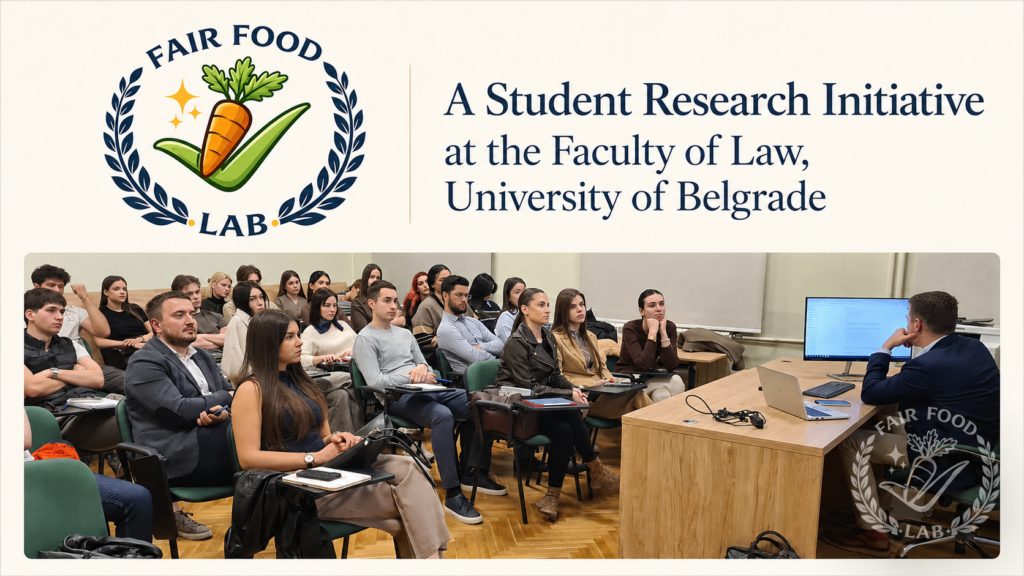
Fair Food Lab is a student research lab at the University of Belgrade Faculty of Law, dedicated to fair, sustainable and trustworthy food systems. It primarily brings together students who attended the Economic Law study group in the 2025/2026 academic year, under the mentorship of Professor Tatjana Jovanić, PhD, together with several additional students who later joined the research initiative. The Lab explores how law, governance, market regulation and education can support food systems that are environmentally responsible, socially fair and institutionally credible. Its work focuses on the links between small producers, consumers, local communities, public authorities and private governance mechanisms.
Our mission is to contribute to fair, sustainable and credible food governance in Serbia and the region. We aim to support public policy innovation, encourage responsible private standards, strengthen consumer trust, improve the position of small producers and educate a new generation of students capable of working across law, governance, sustainability and technology. Food systems are not only economic systems. They are also legal, social, environmental and institutional systems, and require governance models that are transparent, accountable and future-oriented.
Fair Food Lab examines how food systems can become more transparent, resilient and inclusive. We study short food supply chains, community-supported agriculture, producer groups, long-term cooperation between producers and buyers, participatory guarantee systems, animal welfare standards, local quality schemes and fair trade-inspired mechanisms adapted to the Serbian and regional context. Our aim is to understand how legal and governance tools can reduce information asymmetries, build trust, support local production and create credible alternatives.
A central part of our work concerns self-regulatory and co-regulatory models: private standards, trust marks, producer commitments, consumer participation and contractual cooperation that can complement public regulation. Fair Food Lab is grounded in a bottom-up approach to food governance. Rather than viewing regulation only as a top-down function of the state, we examine how fair and sustainable food systems can emerge from the practices and commitments of producers, consumers, communities, students, civil society and responsible market actors. We also ask how public policy can support and scale credible private and community-based governance initiatives.
Our approach combines legal research, policy analysis, comparative study, student research and stakeholder-oriented thinking. We seek to identify regulatory gaps, propose practical governance models and contribute to public policy discussions on sustainable agriculture, circular economy, rural development, consumer protection, responsible consumption and fairer market access for small producers. In modern food systems, public authorities cannot regulate every aspect of trust, quality, sustainability and fairness alone. Credible private standards, participatory verification and responsible contractual networks can play an important role if they are transparent, accountable and designed in the public interest.
Fair Food Lab is also an experiment in responsible AI-supported legal education. Students use AI tools under academic supervision to conduct comparative research, identify regulatory models, assess policy options and test the reliability of digital outputs. AI is not treated as a substitute for academic responsibility, but as a research-support tool within a structured pedagogical framework. Students аre expected to verify sources, compare results, detect inaccuracies and develop their own legal and policy reasoning. In this way, the Lab transforms AI from a shortcut into a pedagogical instrument, combining digital competence with critical judgement and epistemic responsibility.
Fair food governance matters because it connects everyday consumer trust with sustainable production, fairer markets and responsible public policy. For citizens, fair food systems mean trustworthy information about what they buy, where food comes from and under what conditions it is produced. For small producers, they may open new channels of market access and reduce dependence on dominant intermediaries. For public authorities and European partners, Fair Food Lab aims to offer a research and education space relevant to sustainable food systems, circularity, environmental governance, social innovation, legal education, digital transformation and responsible market regulation.
Contact us: fairfood@ius.bg.ac.rs